
Information center / Cancer / Gynecology / Monthly Spotlight / VM Med / Women's health
Subtle Signs of Ovarian Cancer You Shouldn’t Overlook

Ovarian cancer has long been called the “cancer that whispers” a name that reflects one of its most dangerous characteristics. Unlike many other cancers, ovarian cancer rarely announces itself with obvious, localized symptoms in its early stages. Instead, the signs are often vague, easy to dismiss, and frequently mistaken for digestive issues, stress, or aging.
Those whispers are very important to listen for. When ovarian cancer is detected at an early stage, the five-year survival rate exceeds 90%. When detected late, as it is in the majority of cases, that rate drops dramatically.
September is Ovarian Cancer Awareness Month in Canada, a time dedicated to raising awareness, educating women, and encouraging conversations about ovarian cancer symptoms that can often go unaddressed. Understanding the early and subtle signs of ovarian cancer could be lifesaving.
Why Ovarian Cancer Is Difficult to Detect Early
Unlike cervical cancer, there is currently no reliable routine screening test for ovarian cancer. This means that awareness of symptoms, attention to your body, and regular communication with your doctor are your most powerful early detection tools.
Ovarian cancer typically originates in the cells of the ovary, fallopian tubes, or peritoneum (the tissue lining the abdomen). In its early stages, it tends to remain confined to the ovary with minimal symptoms. By the time ovarian cancer symptoms become more pronounced, the disease has often spread to the abdomen and lymph nodes.
Subtle Early Signs of Ovarian Cancer to Know
Many early ovarian cancer symptoms are non-specific, meaning they are common to many conditions. This is why they are so easy to dismiss. If you experience any of the following persistently (for more than 2–3 weeks), and they are new or unusual for you, speak with your doctor:
- Bloating or abdominal swelling: A persistent feeling of fullness, swelling, or pressure in the abdomen. This is one of the most commonly reported early symptoms.
- Pelvic or abdominal pain: A dull, ongoing ache or cramping in the pelvic area, lower abdomen, or even lower back. Ovarian cancer back pain is a frequently overlooked symptom.
- Difficulty eating or feeling full quickly: Feeling full after eating very little, even when you haven’t consumed much.
- Urinary symptoms: Increased urgency to urinate or more frequent urination than usual, without a urinary tract infection.
- Unexplained fatigue: Persistent tiredness that doesn’t improve with rest.
- Changes in bowel habits: Constipation or diarrhea that persists without explanation.
- Nausea or indigestion: Persistent or recurring nausea, heartburn, or upset stomach.
- Pain during intercourse: Unexplained discomfort or pain during sexual intercourse.
- Unusual vaginal discharge or bleeding: Spotting or bleeding between periods, after menopause, or after sex.
According to Ovarian Cancer Canada, these symptoms are most significant when they are new, persistent, and frequent (occurring more than 12 times per month).

Can a Cyst Become Cancerous? What Is the Difference?
Many women are told they have ovarian cysts at some point in their lives, and the natural question is can a cyst become cancerous?
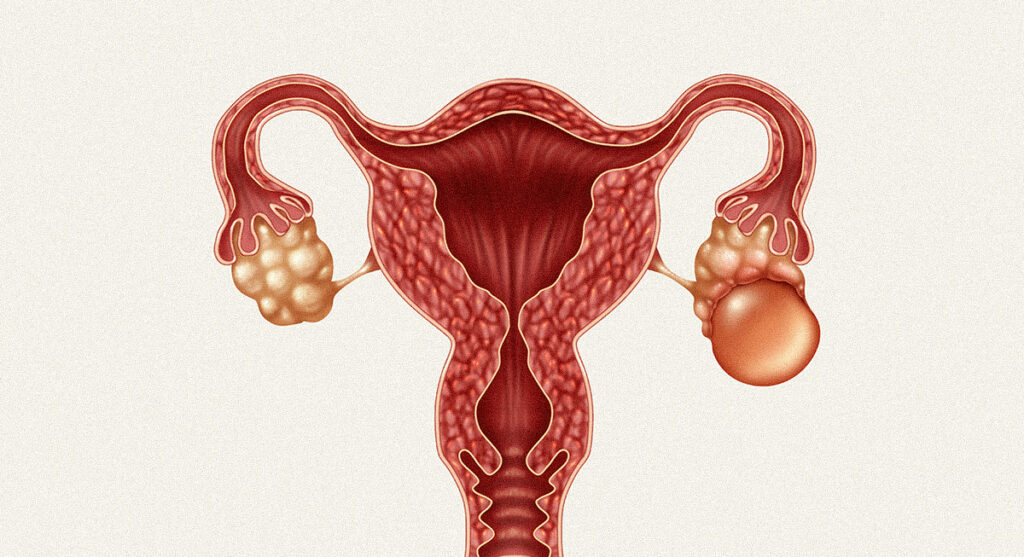
Most ovarian cysts are benign (non-cancerous) and resolve on their own. These are called functional cysts, which form as part of the normal menstrual cycle. They are extremely common, particularly in premenopausal women.
However, certain types of cysts, particularly complex cysts (which have solid areas or irregular features on ultrasound), carry a higher risk of being malignant and require monitoring or removal. Postmenopausal women who develop ovarian cysts should have them evaluated, as the risk of malignancy is higher after menopause.
An ovarian ultrasound is the primary tool used to assess cyst characteristics. If a cyst appears suspicious, your doctor may recommend blood tests (such as the CA-125 tumour marker) and imaging, or a referral to a gynecologic oncologist.
Ovarian Cancer Back Pain: A Commonly Missed Symptom
Lower back pain is one of the most commonly missed early signs of ovarian cancer. Because it is such a prevalent complaint with many causes, like poor posture, muscle strain, or kidney issues, the connection to ovarian cancer is rarely made.
In the context of ovarian cancer, back pain is typically felt in the lower back and/or flanks, and may be accompanied by pelvic pain or bloating. The combination of persistent pelvic/abdominal pain, bloating, back pain, changes in urination or bowel habits is a pattern worth taking seriously and discussing with your doctor. Especially if these symptoms are new and occurring frequently.
Ovarian Cancer Back Pain: A Commonly Missed Symptom
While ovarian cancer can affect any woman with ovaries, certain factors increase the risk:
- Age: Most cases occur in women over 50, after menopause
- Family history: A first-degree relative (mother, sister, daughter) with ovarian or breast cancer
- BRCA1 or BRCA2 gene mutations: Significantly elevate lifetime ovarian cancer risk
- Personal history of breast cancer
- Never having been pregnant
- Endometriosis
- Hormone replacement therapy (HRT) used long-term
- Obesity
If you have one or more of these risk factors, speak with your doctor about whether enhanced monitoring is appropriate for you.
Ovarian Cancer Treatment and Diagnosis
If ovarian cancer is suspected, your doctor will typically recommend:
- Pelvic/transvaginal ultrasound: The first-line imaging tool to examine the ovaries for cysts, masses, or abnormalities.
- Blood tests: Including CA-125 (a tumour marker elevated in many ovarian cancers) and other markers such as HE4.
- CT scan or MRI: For more detailed imaging to evaluate the extent of any masses.
- Surgery/biopsy: Definitive diagnosis of ovarian cancer typically requires surgical removal and pathological examination of tissue.
Ovarian cancer treatment depends on the stage and type, but typically involves a combination of surgery and chemotherapy. When caught at Stage I (confined to the ovary), the five-year survival rate is over 90%. This is why every whisper matters.
Expert Gynecologic Care at VM Med: Dr. Dontigny & Dr. Bouteaud
At VM Med Gynecology Centre in Montreal, our team of specialist gynecologists provides rapid, comprehensive care for women concerned about ovarian health, pelvic symptoms, and gynecologic oncology — with no referral required.
Dr. Lorraine Dontigny (M.D., F.R.C.S.(C)) is an Obstetrician-Gynecologist at VM Med. Her expertise lies in general gynecology, with a special focus on genitourinary syndrome in postmenopausal women. She completed her medical training and residency at l’Université de Montréal, and from 2000 to 2022 was a member of the LaSalle Hospital’s obstetrics and gynecology team. She served as an assistant professor at both McGill University and l’Université de Montréal. Dr. Dontigny performs a range of procedures including colposcopy, hysterosonography, and the MonaLisa Fractional CO2 Laser Therapy.
Dr. Jeanne Bouteaud (M.D., F.R.C.S.C., M.Sc.) is an Obstetrician-Gynecologist at VM Med and an Assistant Professor at Université de Montréal. She completed her medical studies at McGill University and her residency at the University of Montreal, followed by a postdoctoral fellowship in Mature Women’s Health at Mount Sinai Hospital in Toronto. Dr. Bouteaud specializes in menopause management and in the gynecologic follow-up of cancer survivors, including patients with high-risk genetic mutations for gynecological cancers. She is an active member of the Menopause Foundation of Canada and the Canadian Menopause Society.
To book a consultation with Dr. Dontigny, Dr. Bouteaud, or another member of our gynecology team, call or fill out our online form.
Additional Resources
For more information, you can read our extensive archive of VM Med blogs, including Ovarian Cancer: Early Screening and The Different Stages of Ovarian Cancer.
Still have questions? Book a consultation with our experts. We support every aspect of our patients’ gynecological health throughout the course of their lives.
Categories
