

Diagnosis of a Thyroid Problem
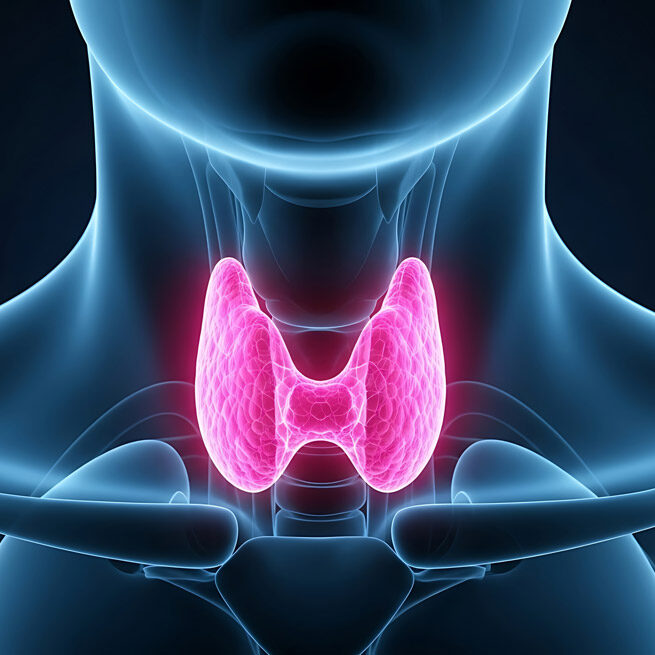
The diagnosis of a thyroid mass is made by taking a medical history and examining the neck. Your doctor may have you lift up your chin, extending your neck to make the thyroid gland more prominent. He/she may also ask you to swallow. This helps to distinguish a thyroid mass from other lumps and bumps in the neck. Other tests that your doctor may order include:
- Fine needle aspiration biopsy.
- Blood tests of thyroid function.
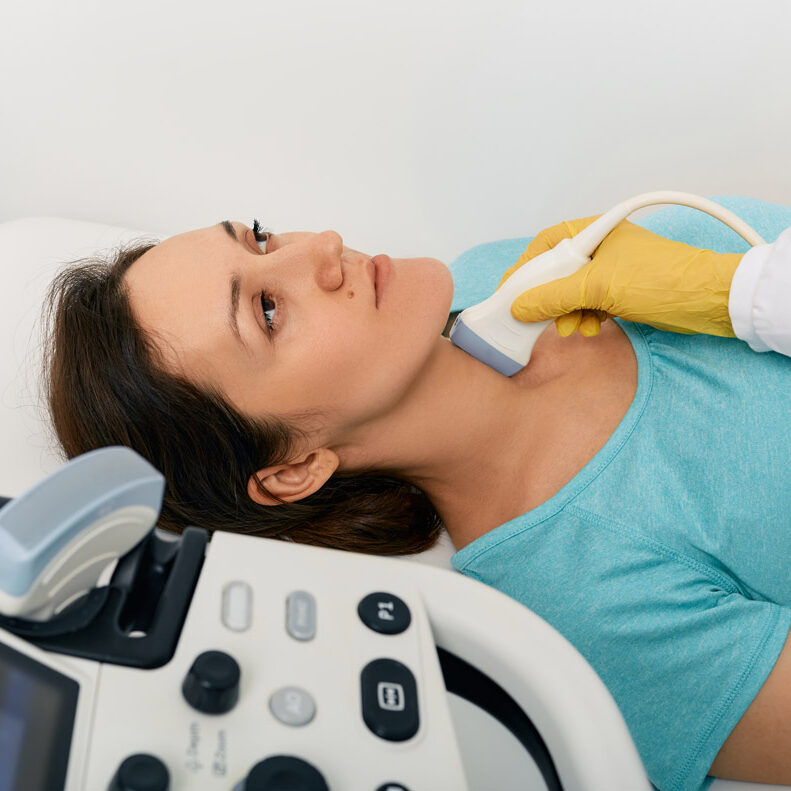
- An ultrasound exam.
- A CT scan.
- A chest X-ray.
- An iodine thyroid scan.
- Core biopsy of the thyroid
- Molecular testing of thyroid nodules
These are all usually available the same day at the VM Med Medical Center.

Fine Needle Aspiration
After diagnosing a thyroid "lump", our multidisciplinary team may recommend a fine or "skinny" needle aspiration of the lump. This is a safe, relatively painless procedure. A fine needle is passed into the lump in the thyroid, ideally under ultrasound guidance, and samples of the tissues are taken. Most patients require several passes with the needle and often a second session may be needed to provide sufficient material for the pathologist. There is little pain and very few complications from the procedure. If you are on blood thinning medication or have a tendency to bleed excessively, this procedure may not be appropriate. This test gives the doctor more information on the nature of the "lump" in your thyroid gland. The results are read by the pathologist. This report will help the VM Med Team to recommend the proper treatment for this thyroid mass.
How to better understand thyroid fine-needle aspiration (FNA) results
Thyroid biopsy results are classified with a standardized system called the Bethesda Classification. This helps physicians and patients understand what was found and what to do next.
The Six Categories:
Category I - Non-Diagnostic – This means we couldn't get a good sample; the biopsy didn't provide enough cells to make a diagnosis. The next step is usually to repeat the biopsy. This result is not always something negative, with cystic nodules (liquid containing nodules) this result is expected and reassuring.
Category II - Benign - This means everything looks normal and the cells look completely benign (non-cancerous). Treatment typically involves just monitoring with periodic ultrasounds and physical exams unless the nodule is large, enlarging or causing symptoms. In this case, radiofrequency ablation or surgery might be an option.
Category III - Atypia Of Undetermined Significance – This means something looks unusual, but we're not sure what. The cells don't look completely normal, but they don't clearly fit into a cancer category either. Options include repeating the biopsy, molecular testing (genetic tests on the biopsy sample), or sometimes just careful monitoring.
Category IV – Follicular neoplasm – This means the biopsy results look suspicious for cancer but our doctors can't be certain from the biopsy alone. This category is subdivided into "suspicious for follicular neoplasm" or "suspicious for Hürthle cell neoplasm." Options include molecular testing (genetic tests on the biopsy sample) or surgery.
Category V – Suspicious for Malignancy - This means the results strongly suggest cancer but there's still a small chance it could be benign. Surgery is almost always recommended, often involving removal of the entire thyroid gland, especially if the nodule is large or there are other concerning features.
Category VI – Malignant - This result means there is definitely cancer present, and the diagnosis is clear-cut malignancy. Treatment involves surgical removal of the thyroid, and depending on the type and extent of cancer, possibly radioactive iodine treatment afterwards and lifelong thyroid hormone replacement.
Additional Considerations
The treatment approach also depends on other factors like the size of the nodule, age, family history, and whether there are concerning features on ultrasound. For categories III and IV, molecular testing is increasingly used to help refine the risk assessment and guide treatment decisions.
For any surgical option, you'd work with one of our specialized endocrine surgeons for ongoing management. The good news is that most thyroid cancers, when caught early, have high cure rates.
This classification system helps ensure everyone - your primary doctor, specialists, and you - are on the same page about what the biopsy showed and what the most appropriate next steps are based on current medical evidence.
Make an Appointment
Online inquiries are answered as soon as possible during regular business hours.
The fastest way to reach us is by completing the online inquiry form below.
In case of an emergency, please dial 911.
514-933-2778
1-800-849-6048
514-788-1484
Monday to Friday: 8:00 – 16:00 Saturday: Closed
Sunday: Closed
Why is VM Med
the right choice?
Opting for healthcare services at our private clinic ensures patients receive excellent and timely care with a specialist. Comprehensive exams, including the consultation, ultrasound and biopsy (if needed) are conducted onsite, and results are provided within 72 hours.
